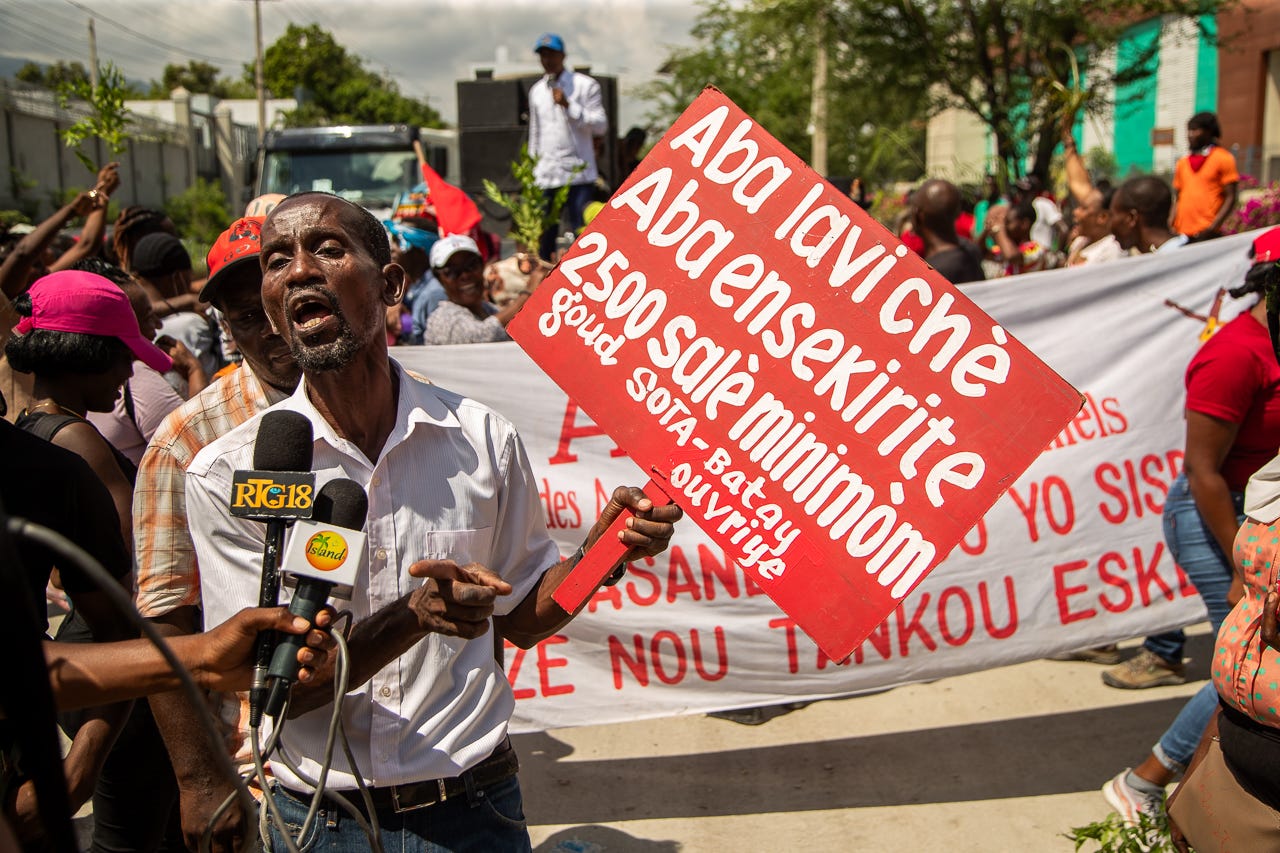
Following major strikes and demonstrations, the Haitian government agreed this week to open negotiations with unions and peasant movements regarding a minimum wage increase. All that and much more in issue #63 of HAITI WEEKLY by DÈYÈ MÒN ENFO.
Editor’s note: Thanks to your support, we can continue publishing. Your contribution enables us to produce exclusive, rigorous, high-quality on-the-ground reporting. Thank you to everyone who, to the best of their ability, chooses to support us with a paid subscription.
Summary #63
Wage Hike Talks: Minimum-wage Negotiations Underway
Music Video of the Week: Devan l ye by Zile
Expo Jeunes: A Festival of Flavors
Jeunesse en avant: Basketball in the Spotlight
Nazon Reopens, Delmas 30 Rebuilds
In the Plaine, the Coalition is Fracturing
Press Reviews
Wage Hike Talks: Minimum-wage Negotiations Underway
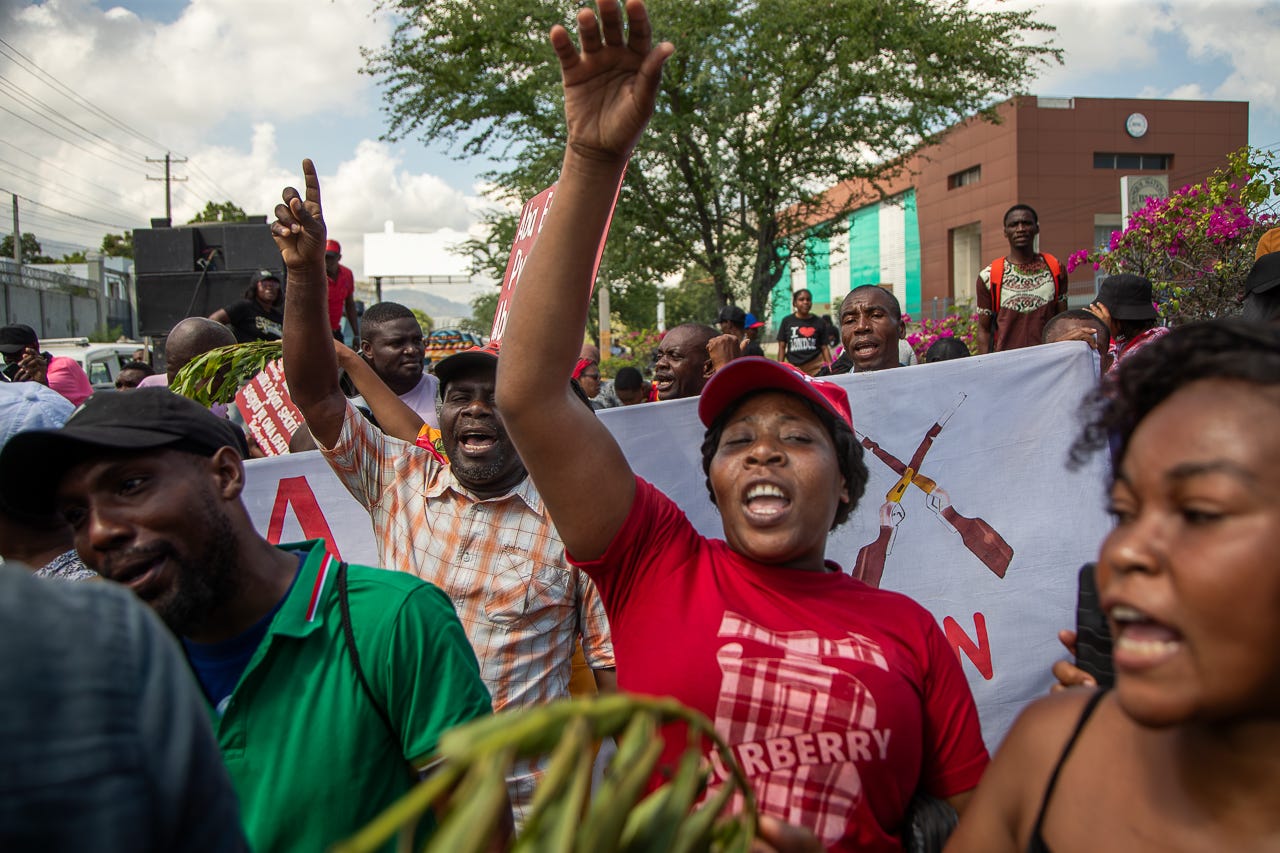
Since Thursday, the government has finally agreed to sit down with several union federations and peasant associations to consider raising the minimum wage, after nine days of strikes last month led by factory workers in Port-au-Prince and Ouanaminthe, two of the country’s largest industrial hubs.
“After the government’s decision in early April to raise fuel prices, workers felt they could no longer absorb the rising cost of living,” explained Télémarque Pierre, general coordinator of the ESPM–Batay Ouvriye federation, reached by phone yesterday morning just before another day of negotiations with the government.
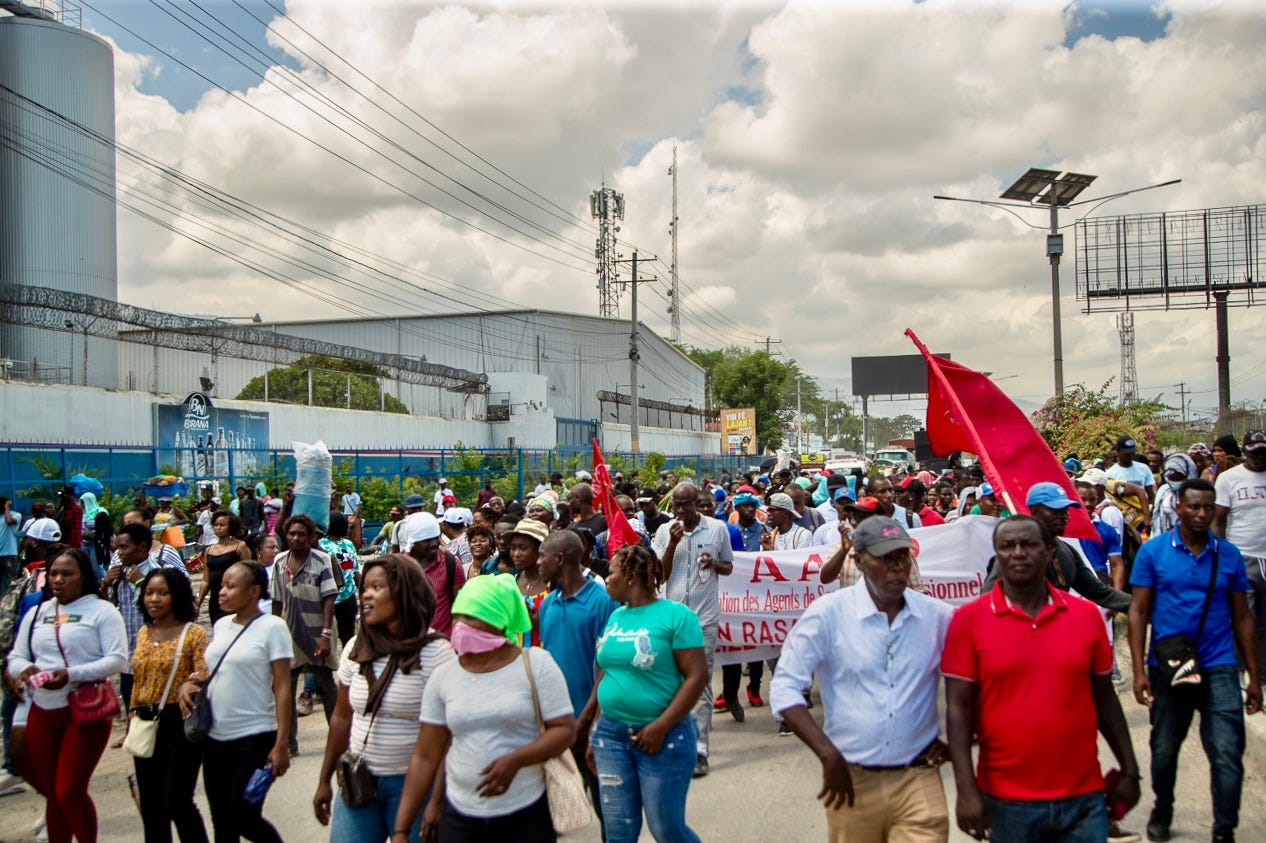
Since the conflict between criminal groups and authorities began five years ago, annual inflation has remained around 30%. Meanwhile, the minimum wage has remained at 685 gourdes per day since 2022 (just over 7 Canadian dollars or 5 USD).
The mobilization began with three days of strikes in factories in mid-April, followed by three more days of strikes from April 20 to 22. Then, there were three additional days of strikes and demonstrations on April 29 and 30, as well as on May 1, which is International Workers’ Day and a public holiday in Haiti.
In talks that began this week, the government proposed raising the minimum wage to 1,000 gourdes per day (a little over 10 Canadian dollars, or 7.60 USD). That is not enough, according to Pierre. Given the steep rise in the cost of living, unions are demanding 3,000 gourdes per day instead.
“1,000 gourdes can’t cover basic needs for food,” the union leader explains. For example, 1,000 gourdes only pays for a plate of rice and meat from a street vendor in Port-au-Prince.
In Haiti, the government sets the minimum wage according to a grid based on job type. The 1,000-gourde proposal would apply to entry-level factory jobs. Under the government’s proposal, domestic workers’ wages would rise from 350 gourdes to 500 gourdes, and security guards’ from 615 gourdes to 925 gourdes.
These negotiations are being held with the Ministry of Finance and the Ministry of Social Affairs and Labor, at the offices of the Economic and Social Assistance Fund (FAES).
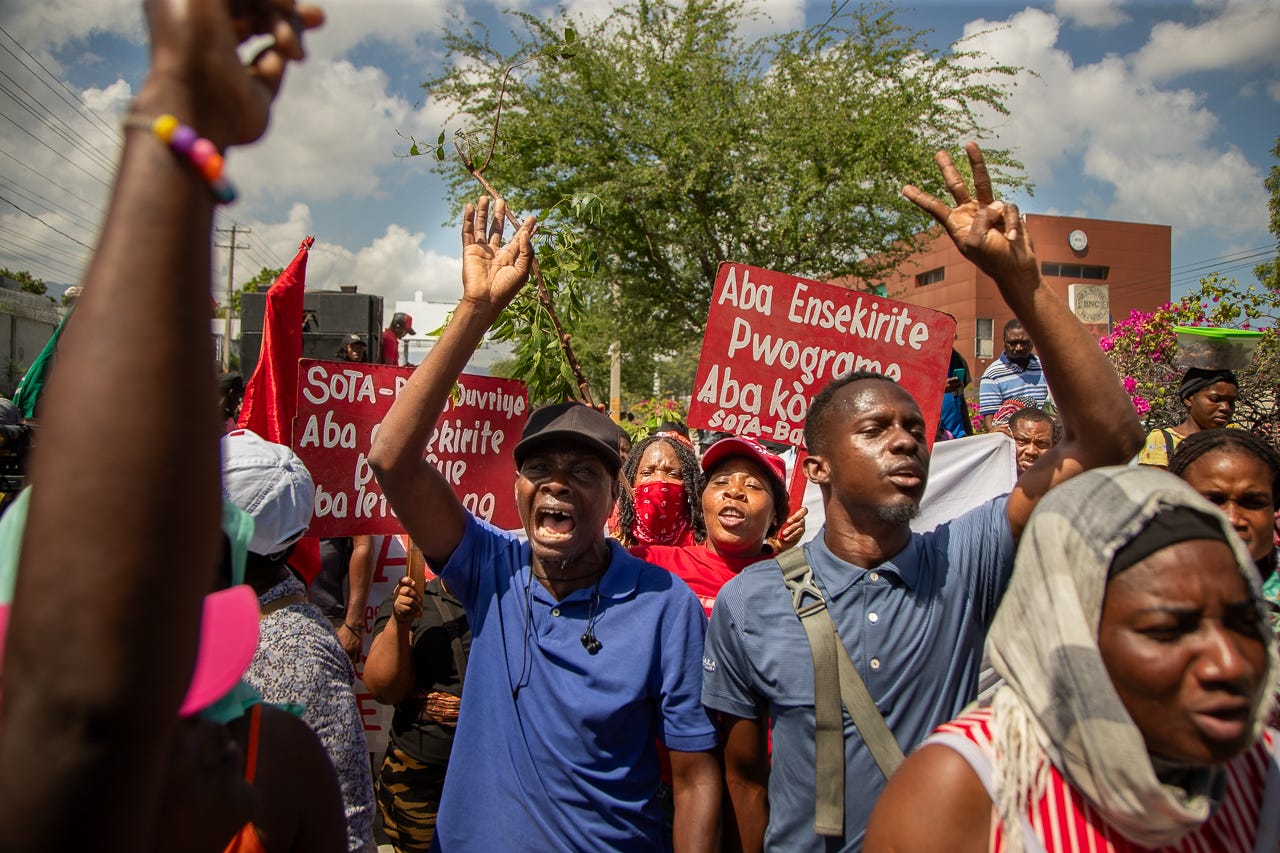
“The workers’ demands are a minimum-wage floor of 3,000 gourdes, with no new price increases, lower gas prices, and that all employees arbitrarily and illegally dismissed at the CODEVI factories be reinstated, in line with respect for freedom of association.”
Around fifty union leaders and employees who participated in the strike were reportedly fired from factories in Ouanaminthe following the demonstrations.
“We’re calling on all workers to stay mobilized,” he concluded. “We’re consulting so that unions can adopt an official position on the government’s proposals.”
Factories in the Port-au-Prince (SONAPI) and Ouanaminthe (CODEVI) free-trade zones produce goods for Haiti and North America, such as low-cost clothing.


Music Video of the Week
Devan l ye - Zile
Led by Annie Alerte, the band Zile is enjoying success once again with its latest music video, Devan l ye (“look ahead”), which was released last Friday. A tribute to compas direct, the track features a horn section in the pure tradition of the genre, which was particularly popular before the 1990s.
In the video, a crowd in the street holds up signs bearing the names and images of some of the most important figures in compas direct. The signs are shown on screen at the very end. The song emphasized the importance of looking toward the future while remembering the past. It also recounts the journey of Annie Alerte, the group’s lead singer. As a child, she appears in front of a mirror singing into a hairbrush in a working-class neighborhood. Meanwhile, the adult singer travels by private jet and Mercedes before returning to visit the little girl she once was.
Expo Jeunes: A Festival of Flavors

In late April, the Delmas municipal hall in the Delmas 33 neighborhood hosted the sixth edition of the Expo Jeunes food fair, organized by Real Productions.
The event featured dozens of booths showcasing local products, including food and crafts. Several stars of the Haitian music scene performed in the evening, including Kreyol La, Teddy Hashtag, Bmix & Afriken, DJ YK, and Joel Akoustik. Our friends at Fragrance by Rudel were also on site (first photo).


A fashion show featuring Haitian designs was also included in the program this time.


Jeunesse en avant: Basketball in the Spotlight

The Jeunesse en avant basketball championship is currently underway in the capital, with a new edition taking place. This tournament provides an opportunity for teenagers to showcase their talent before advancing to the adult league. The event is supported by the Haitian Basketball Federation.
In the final matchup between Levante and Team Christ Roi, Team Christ Roi won the game (50–33) and the series. The game was played on April 19 at Place Boyer in Pétion-Ville.


Nazon Reopens, Delmas 30 Rebuilds
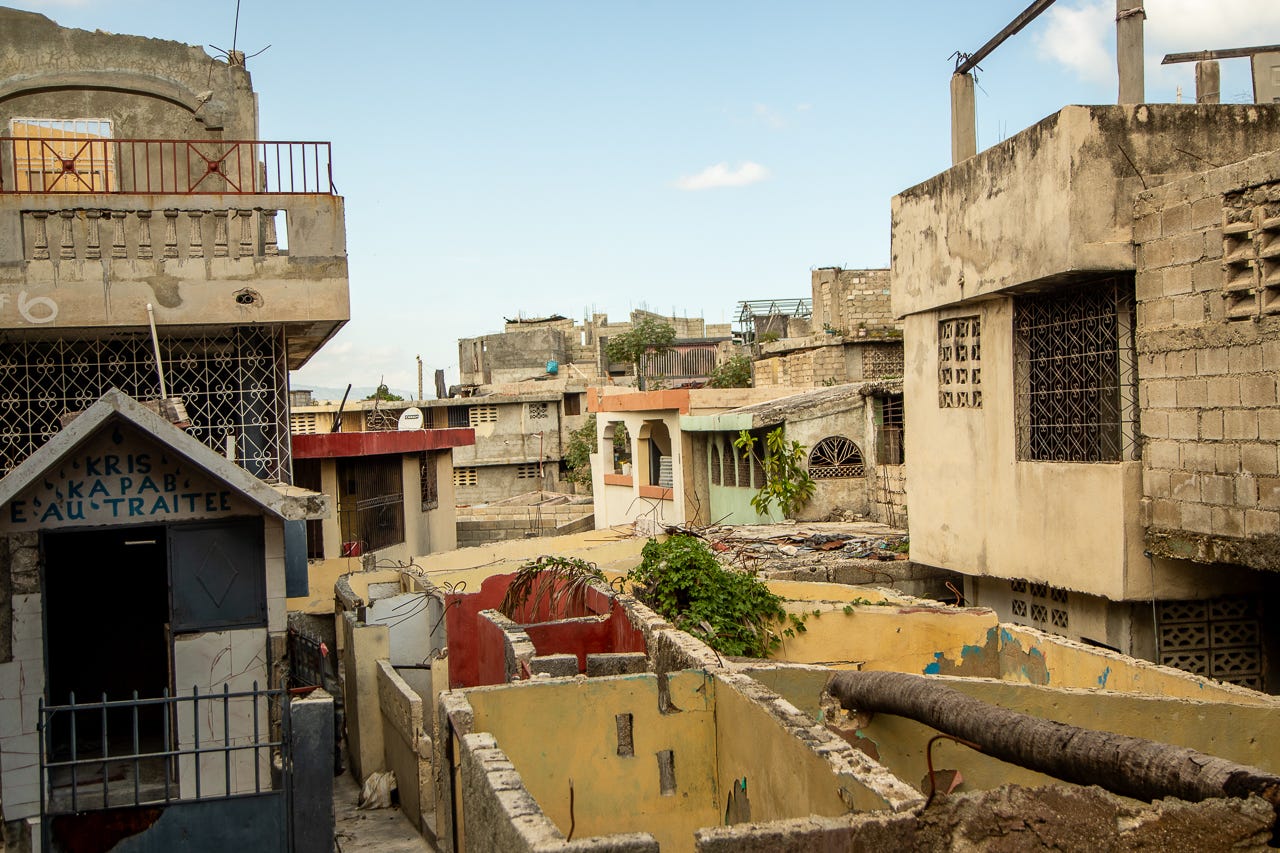
In recent weeks, a certain calm has been observed in the Nazon and Delmas 30 neighborhoods, following violent attacks by criminal groups in areas close to downtown Port-au-Prince. The armed groups appear to have retreated to their traditional strongholds, enabling some residents to return to home or assess the damage.

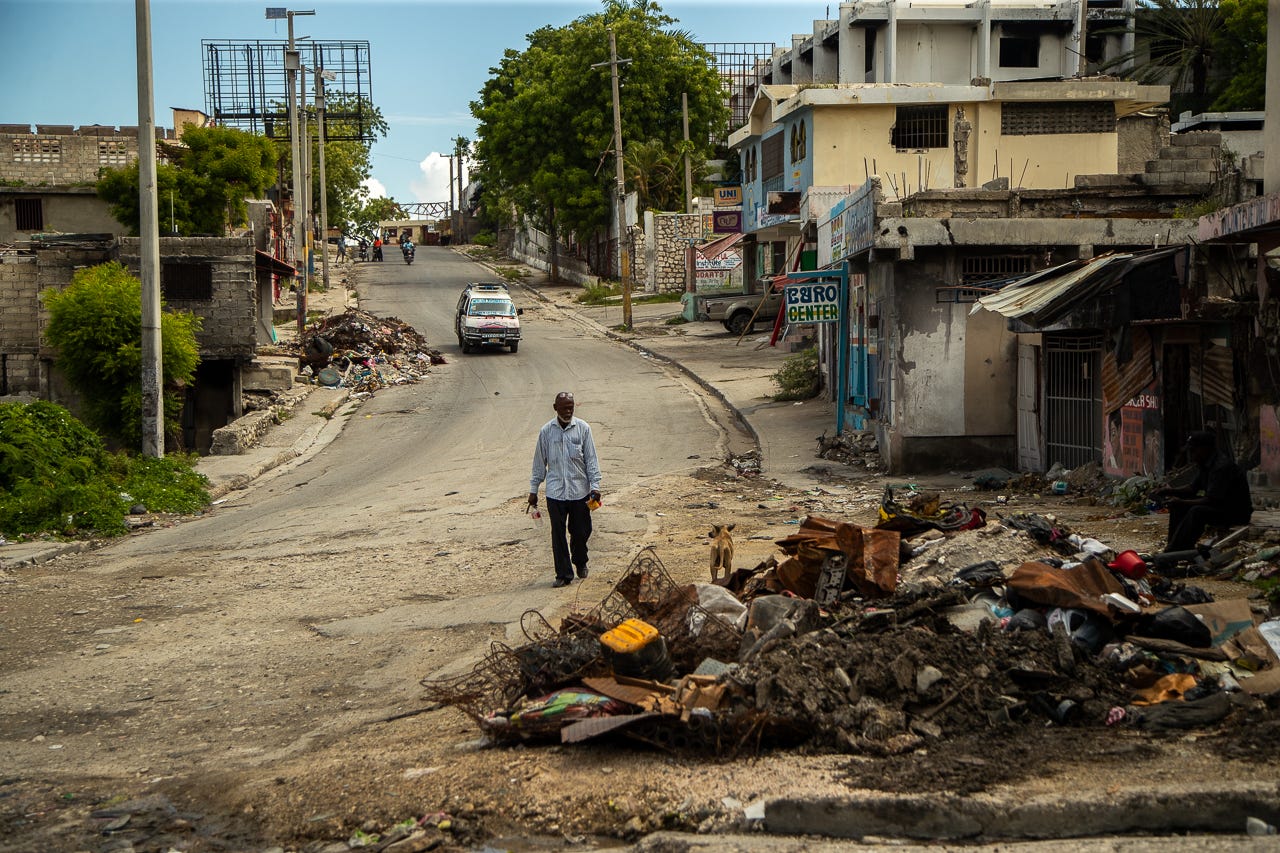
Based on our observations, many homes were burned and numerous sheet metal roofs were torn off. Traffic is also gradually returning to Nazon Road, where we saw buses (tap-taps) back in service on this major artery that had been closed for over a year.
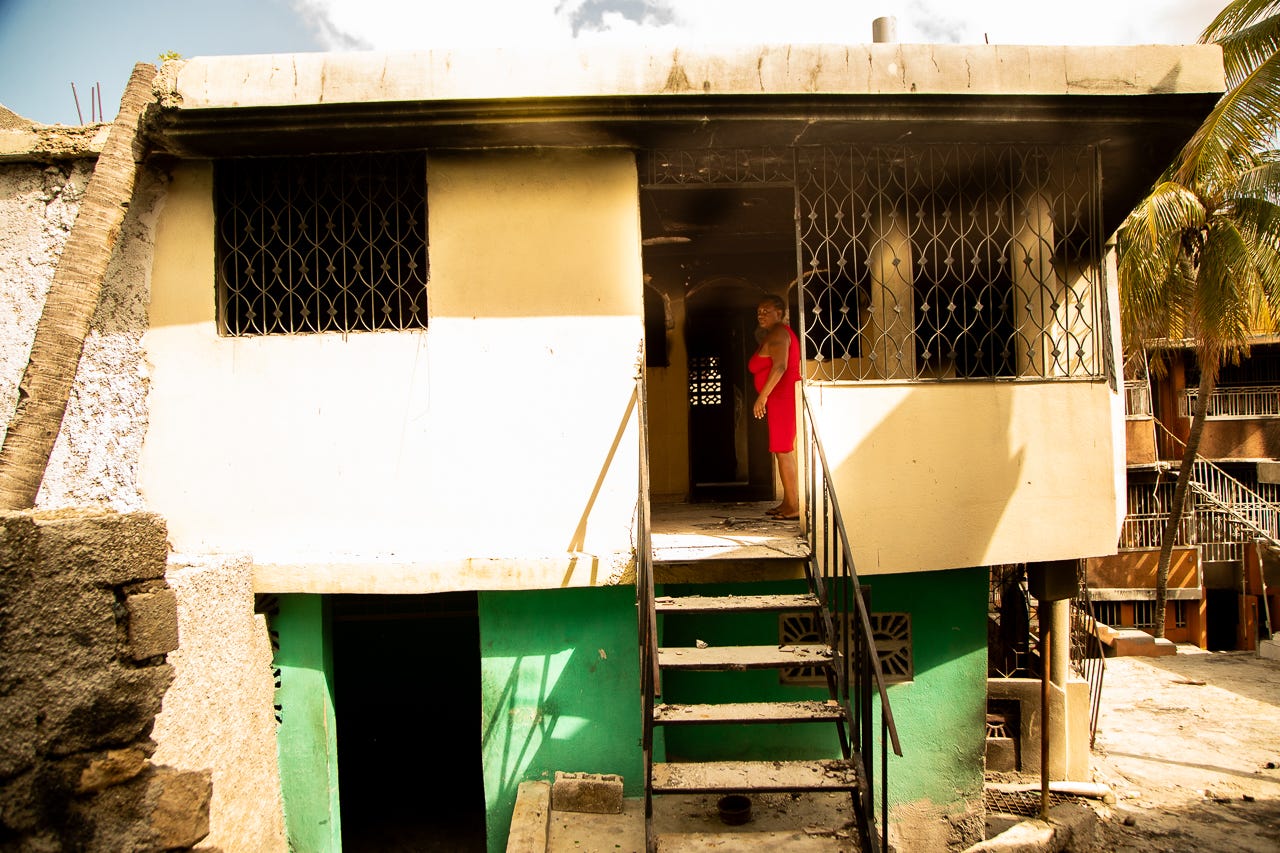
In the Plaine, the Coalition is Fracturing
Tensions persist among members of Viv Ansanm, an armed criminal coalition that controls the area surrounding Port-au-Prince, including the city center.
Two weeks ago, new clashes took place in the Plaine, an area bordering Cité-Soleil and Tabarre, especially around Petite Place Cazeau and Damien in the northern outskirts of Port-au-Prince. According to the International Organization for Migration, three groups within the coalition are fighting for control of territory, triggering the forced displacement of 5,000 people. There are strong rumors that further attacks are being prepared following these initial clashes, which reportedly caused many deaths among the groups involved. Tè Nwa, a group based in Pierre 6, is reportedly attempting to seize territory from the Chen Mechan group (“Mean Dogs”) and its allies in the Taliban group, based in Canaan and led by a man known as Jeff Gwo Lwa.

Controlling certain intersections enables the installation of makeshift toll checkpoints, which generate significant income for these groups. Meanwhile, the U.S. embassy remains protected by U.S. Marines, though its doors are still closed to the public. Companies such as Barbancourt, a rum producer, and Comme il faut, a cigarette producer, which are also located near conflict zones, have called for help in a joint letter.
DÈYÈ MÒN ENFO’s team
Photojournalists: Francillon Laguerre, Sonson Thelusma, Andoo Lafond, Milot Andris, Patrick Payin, Ketlain Difficile, Steeve Saint Fleur, Clarens Siffroy
Community manager: Steven Andris
Editorial board: Etienne Côté-Paluck, Jean Elie Fortiné, Jean-Paul Saint-Fleur
Interns: Wilky Andris, Donley Jean Simon
Special collaboration: Stéphanie Tourillon-Gingras, Mateo Fortin Lubin, Dickens Lundi
Media partners: Centre à la Une, J-COM, Nord-Est Info
Institutional partners: Kay Fanm, Mouka.ht


How Does Your Contribution Help?
Your monthly (or yearly) support helps to finance the production and pay the salaries of the DÈYÈ MÒN ENFO staff in the communities of Cité-Soleil, Port-au-Prince and Cayes-Jacmel. In addition, donations are regularly distributed for medical expenses, school fees and other emergencies in these communities.
Press Reviews
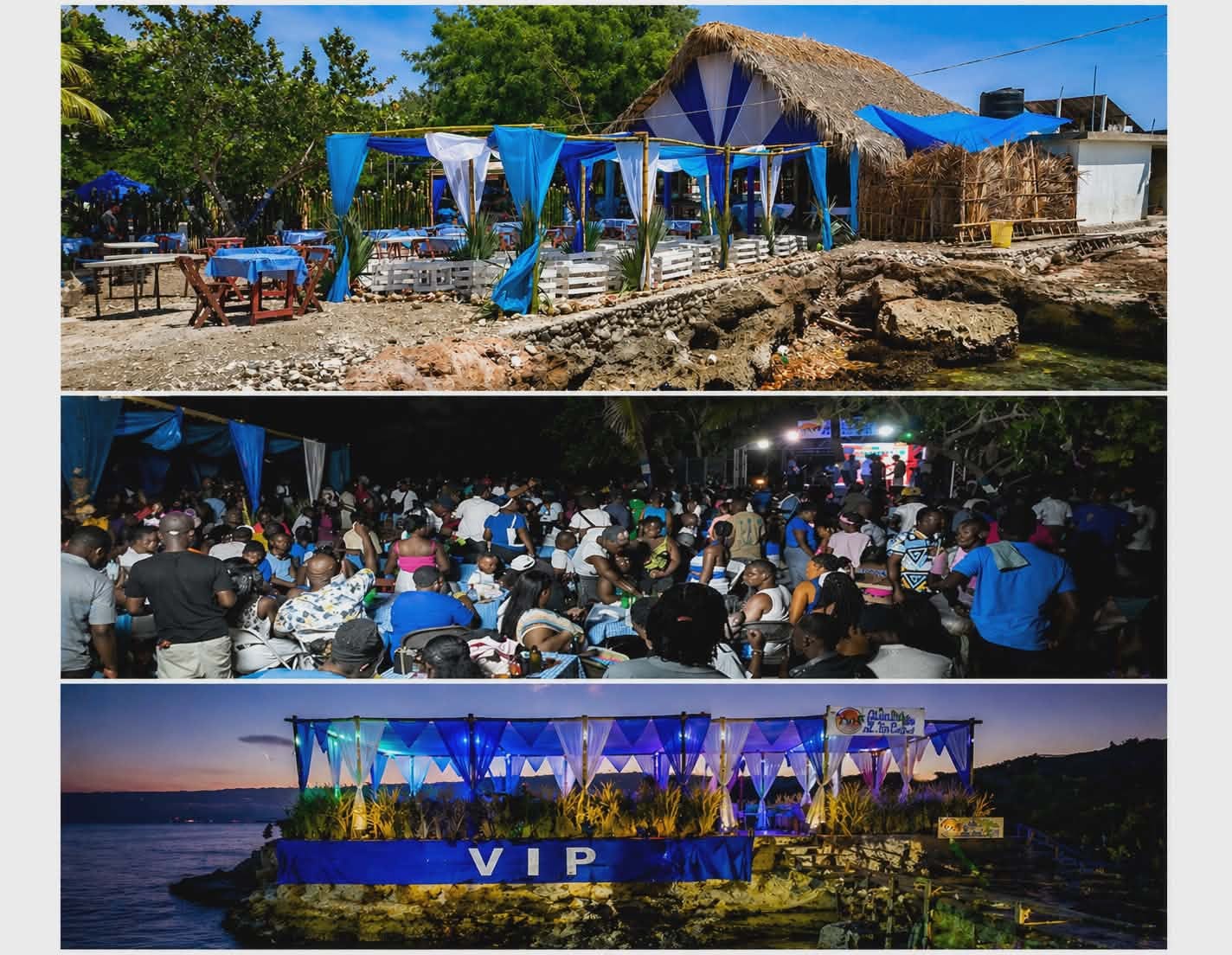
Press Review - Performing Arts
SST: Gaëlle Bien-Aimée and Cantave K. Dismantle the Country Through Laughter - Le Nouvelliste
Atelye Mawon, or Dance as Memory and Artistic Practice - Le Nouvelliste
Lynn Williams Rouzier Dance Institute: 60 Years of Dance and Passing on Knowledge - Le Nouvelliste
At the Crossroads of Islands, an Attempt at Liberation Through Imagination - Le Nouvelliste
Press Review - Cinema
“Cannes 2026, an Indescribable Emotion,” Says Gessica Généus, Who Is Presenting Their Next Film There - Le Nouvelliste
Haiti – Cinema: Gessica Généus Selected for Cannes With “Marie-Madeleine” - AlterPresse
Press Review - Culture & Heritage
Fort Dimanche: Memory Commemorated, but Official Silence Around April 26 - AlterPresse
Haiti – Culture: the Pyepoudre Cultural Center Celebrates 37 Years - AlterPresse
Haiti–UN: an Afro-Descendant Collective Demands the Restitution of Cultural Goods Looted During Colonization- AlterPresse
Delmas Municipal Library Reopens - Le Nouvelliste
Press Review - Gender & Women’s Rights
présentée par KAY FANM
“Veye sou nou”: a Collective Commitment for the Women of Haiti - Fondation Connaissance et Liberté